When deciding where to build your career in South Africa, the choice almost always comes down to two major hubs: Johannesburg and Cape Town. Both cities are economic powerhouses, but they offer completely different work environments, industry focuses, and career trajectories.
To give you a clear, data-driven picture of how the two job markets compare, we analysed job listings posted on MyJobMag South Africa across two equal study periods:
2025 Study Period: 1 January 2025 to 19 October 2025
2026 Study Period: 1 January 2026 to 19 October 2026
So, which city actually offers better job opportunities? The short answer: it depends on what you do and what you value most in your career. Johannesburg remains the major commercial engine with a higher volume of corporate and industrial vacancies, while Cape Town continues to strengthen its grip on tech, creative industries, tourism, and remote-friendly roles.
Let's break down the figures to see how these markets compare.
The table below provides a clear, straightforward comparison of total job advert volumes, year-on-year growth, and average earnings across both cities:

Data source: Aggregated analysis of vacancy listings on MyJobMag South Africa (1 Jan–19 Oct 2025 vs 1 Jan–19 Oct 2026).
If you are comparing based on the number of job opportunities, Johannesburg wins on total vacancy volume.
As South Africa’s economic hub and home to the headquarters of over 70% of major corporate entities, Joburg consistently produces more job openings than any other municipality. During the 2025 period, Johannesburg accounted for nearly six out of every ten vacancies listed across South Africa’s main metropolitan areas on MyJobMag.
However, the growth trajectory tells a more detailed story:
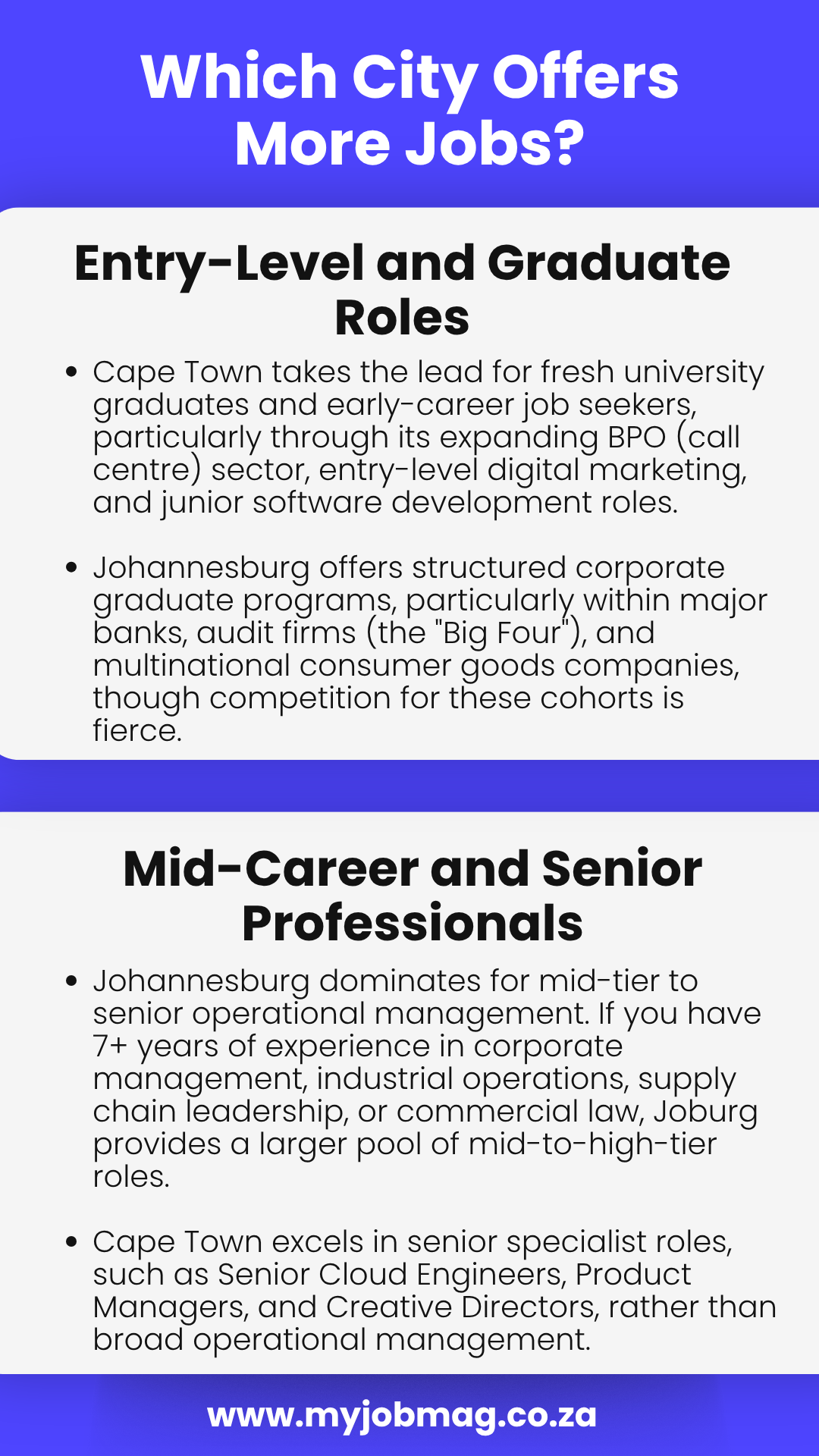
Johannesburg experienced steady but modest growth (+3% year-on-year). Corporate hiring in Gauteng remains strong in core sectors. However, recruitment is largely focused on replacement hiring and structural consolidation.
Cape Town saw a faster year-on-year growth rate (+6% year-on-year), driven by an influx of tech startups, boutique financial services, offshore customer experience hubs, and green energy projects.
So, what does this mean for job seekers? It means that if you are casting a wide net or working in broad corporate fields like general management, logistics, heavy sales, or commercial operational roles, Johannesburg offers a higher volume of options. However, Cape Town’s job market is expanding at a faster clip, meaning more net new roles are opening up relative to its size.

The economic footprints of the two cities influence which career paths thrive in each location. Looking closely at job categories on MyJobMag reveals clear sector specialisations:
Vacancies in Johannesburg are mainly offered by the heavy industry and large-scale service sectors such as:
Banking, Finance & Accounting: Johannesburg leads in institutional banking, commercial audit, and corporate finance roles.
Engineering & Construction: Structural, civil, mechanical, and industrial engineering vacancies show a much stronger concentration in Gauteng.
Supply Chain, Logistics & Procurement: As Africa’s primary inland trade hub, warehouse operations, supply chain planning, and freight management dominate local listings.
Medical & Healthcare: Large hospital networks, pharmaceutical headquarters, and medical supply companies generate substantial medical listings.
Cape Town has positioned itself as Africa’s primary technology and innovation hub, offering job opportunities primarily in these fields:
IT & Software Development: Web development, data engineering, UI/UX design, and cloud architecture roles are noticeably denser in Cape Town.
Digital Marketing, Media & Creative: Advertising agencies, e-commerce brands, and content studios concentrate their recruitment efforts along the Western Cape coast.
Business Process Outsourcing (BPO) & Customer Experience: International call centres and managed service providers have expanded rapidly in Cape Town, offering thousands of entry-level and customer support roles.
Renewable Energy & Sustainability: Solar engineering, ESG consulting, and clean technology roles show higher recruitment density in Cape Town.
When reviewing advertised figures on MyJobMag, Cape Town edges out Johannesburg slightly on average advertised earnings, though contextual nuances matter.
Cape Town: Average/median advertised salary stands at approximately R374,173 per year.
Johannesburg: Average/median advertised salary stands at approximately R359,285 per year. (Note: Specific business nodes like Sandton benchmark at around R358,728).
Source: MyJobMag 2026 Salary Guide for South Africa.
The wage gap isn't necessarily because local firms pay more across the board. Rather, Cape Town's average is lifted by:
A higher concentration of international tech companies and foreign-funded startups paying global rates.
A large proportion of specialised software, data, and design roles that carry higher baseline compensation.
In contrast, Johannesburg offers higher pay for senior executive, corporate finance, heavy engineering, and specialised industrial roles.
Career stage plays a significant role in determining where you will find the best match:
Work arrangements differ significantly between Gauteng and the Western Cape:
Johannesburg: [ On-Site: 55% ] [ Hybrid: 38% ] [ Remote: 7% ]
Cape Town: [ On-Site: 35% ] [ Hybrid: 48% ] [ Remote: 17% ]
Cape Town leads in Remote & Hybrid flexibility: Nearly two-thirds of Cape Town vacancies on MyJobMag offer hybrid or fully remote arrangements. The city's thriving tech ecosystem and international client base make employers far more comfortable with flexible working models.
Johannesburg remains predominantly On-Site & Hybrid: While hybrid models have been widely adopted across Johannesburg's financial and professional services sectors, industrial, manufacturing, logistics, and healthcare roles still mandate physical on-site presence. Fully remote roles remain a small minority of total Joburg listings.
Moving between provinces is a major life decision. Choosing where to go depends heavily on your industry, career stage, and lifestyle preferences.
You work in traditional corporate sectors: Mining, heavy engineering, corporate banking, supply chain, logistics, or industrial sales.
You want more volume: You want access to the largest number of opening vacancies to increase your chances of landing a job quickly.
Cost of living relative to housing: While Johannesburg everyday expenses vary, housing and rental properties generally offer significantly more space and lower square-meter prices than equivalent locations in Cape Town.
You work in tech, creative, or green energy: Software development, UI/UX, digital marketing, renewable energy, or boutique finance.
You value workplace flexibility: You are actively seeking remote or hybrid work environments.
Lifestyle is a top priority: You prefer coastal living, public outdoor infrastructure, and are willing to navigate a tighter, more expensive residential rental market.
Johannesburg consistently lists a higher total volume of job vacancies due to the high density of corporate headquarters, industrial bases, and commercial enterprises in Gauteng.
Cape Town offers more high-volume entry-level positions in customer support, BPO, and junior tech roles. Johannesburg offers larger, structured corporate graduate schemes, though entry requirements are highly competitive.
Cape Town shows a slightly higher average advertised salary (R374,173 vs R359,285) due to its high concentration of tech and international roles. However, Johannesburg frequently pays higher top-end salaries for executive management, mining, and corporate engineering roles.
Cape Town offers significantly more remote and hybrid job openings than Johannesburg, largely driven by its software development, e-commerce, and agency ecosystems.
Neither city holds a total monopoly on career growth, as the right choice comes down to your personal career path:
Johannesburg remains South Africa’s commercial engine room. It is best suited for professionals aiming for vertical mobility in corporate structures, heavy industry, finance, and logistics.
Cape Town is South Africa’s innovation capital. It is ideal for tech specialists, creative minds, remote workers, and those in the green economy or BPO sectors.
Ready to take the next step in your job search? Explore the latest vacancies, filter by work arrangement, and apply directly on MyJobMag South Africa today:
Browse Jobs in Johannesburg
Browse Jobs in Cape Town

Hello, we are a team of experienced recruiters and we are happy to help you recruit your next team member.
Contact Us
Leave a Comment